
Up to 80% of neurodivergent adults experience unemployment, yet the interview process itself remains one of the most significant barriers standing between talented candidates and meaningful work. Traditional recruitment formats, built around unspoken social conventions and rapid-fire verbal exchanges, were never designed with neurodivergent minds in mind. For HR professionals and hiring managers committed to genuine inclusion, that gap represents both a challenge and an opportunity. This article walks through the specific barriers neurodivergent candidates face, how to reshape your interview environment, practical preparation steps, and the common pitfalls that undermine even well-intentioned efforts.
Table of Contents
- Understanding neurodivergent interview barriers
- Preparing the environment for neurodivergent inclusion
- Step-by-step neurodivergent interview preparation
- Overcoming common interview pitfalls
- A fresh perspective on neurodivergent interview readiness
- Where inclusive interview preparation meets real results
- Frequently asked questions
Key Takeaways
| Point | Details |
|---|---|
| Barriers to inclusion | Traditional interviews can unintentionally exclude neurodivergent candidates unless barriers are addressed. |
| Effective preparation steps | A systematic approach to interview readiness improves outcomes for candidates and organisations. |
| Accommodations make a difference | Simple, low-cost adjustments significantly boost retention and productivity. |
| Avoid common pitfalls | Understanding and correcting frequent mistakes ensures more equitable hiring. |
| Practical resources available | There are proven tools and support packages to help HR teams prepare inclusive interviews. |
Understanding neurodivergent interview barriers
Neurodivergent candidates, including those with autism, ADHD, dyslexia, dyspraxia, and related conditions, bring genuine strengths to the workplace. Pattern recognition, deep focus, creative problem-solving, and exceptional attention to detail are frequently cited advantages. Yet the standard interview format actively works against these strengths.
Consider the disclosure question first. A striking 76% of neurodivergent candidates choose not to disclose their condition during recruitment, primarily because of perceived stigma. That silence has consequences. Without disclosure, candidates cannot request reasonable adjustments, and hiring managers cannot tailor the process. Both sides lose.
The barriers go beyond disclosure. Traditional interviews rely heavily on:
- Unstructured conversational formats that reward neurotypical social fluency
- Ambiguous questions such as "Tell me about yourself" that lack clear parameters
- Eye contact and body language cues used as proxies for confidence or competence
- Rapid context-switching between topics with little signposting
- Noisy or visually busy environments that create sensory overload
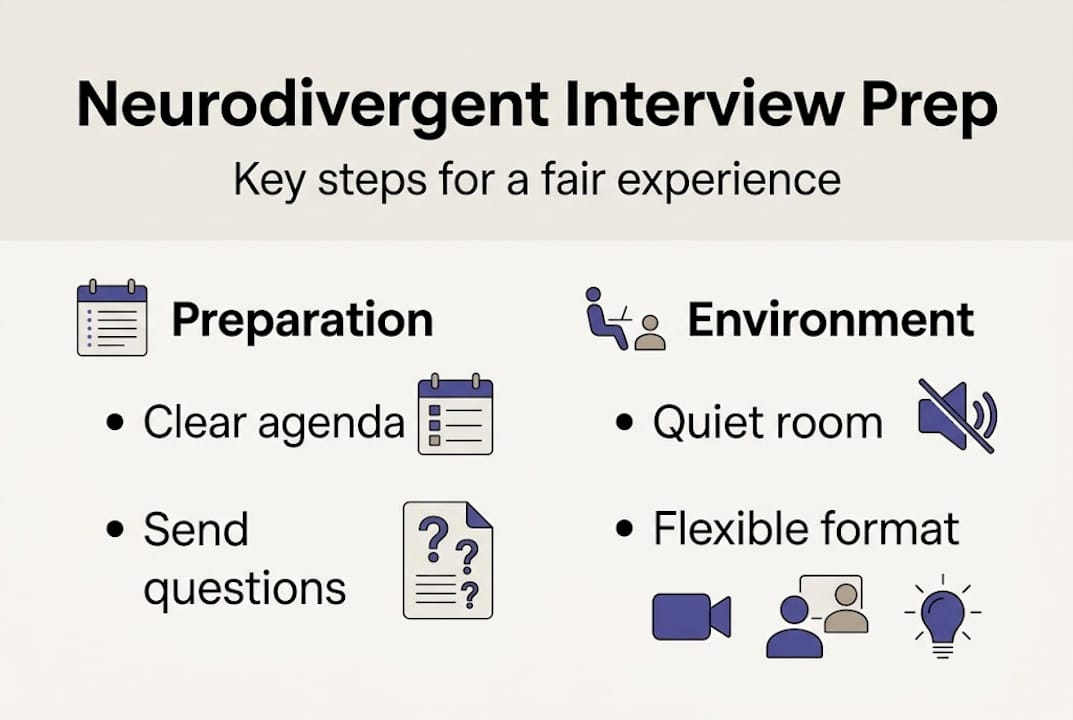
These are not minor inconveniences. They are structural filters that screen out neurodivergent talent before skills are ever assessed. The good news is that most accommodations require no financial outlay at all. Sending questions in advance, offering a quiet room, or allowing written responses instead of verbal ones are changes that cost nothing but signal everything about your organisation's values.
"Recruitment is consistently cited as the primary barrier to neurodivergent employment, yet the adjustments that make the biggest difference are often the simplest ones."
Looking at neurodivergent case studies from organisations that have made these shifts reveals a consistent pattern: when the format changes, the quality of candidate responses improves dramatically. The talent was always there. The process was the problem.
For hiring managers looking to move beyond instinct and build something repeatable, building effective interview strategies is a practical starting point that translates these principles into structured action.
| Barrier | Impact on candidate | Low-cost fix |
|---|---|---|
| Ambiguous questions | Anxiety, under-performance | Send questions 48 hours ahead |
| Sensory environment | Cognitive overload | Quiet room, neutral lighting |
| Eye contact expectation | Misjudged as disengaged | Brief panel on body language norms |
| Rapid topic changes | Difficulty processing | Clear agenda shared in advance |
Preparing the environment for neurodivergent inclusion
Once you understand the barriers, the next step is reshaping the interview environment itself. This goes beyond ticking a legal compliance box. It means creating conditions where neurodivergent candidates can actually demonstrate what they are capable of.

Legal frameworks such as the Equality Act 2010 in the UK establish a baseline obligation to make reasonable adjustments. But compliance and inclusion are not the same thing. Implementation gaps persist, with some organisations reporting accommodation delays of up to 70%, meaning candidates face barriers even when adjustments are theoretically available. Proactive cultural shifts outperform reactive compliance every time.
| Approach | Compliance-led | Culture-led |
|---|---|---|
| Motivation | Avoid legal risk | Attract and retain talent |
| Timing | Reactive, post-request | Proactive, built into process |
| Outcome | Minimum adjustment | Optimised candidate experience |
| Team involvement | HR only | Whole hiring team trained |
Practical environmental changes to implement now:
- Lighting: Swap fluorescent overhead lights for warmer, adjustable alternatives
- Seating: Offer candidates a choice of seating position and distance from the panel
- Breaks: Build in a short pause mid-interview, especially for longer formats
- Written options: Allow candidates to answer some questions in writing if preferred
- Structured agendas: Share the interview format and topic areas at least 48 hours before
Pro Tip: When you create an inclusive job specification from the outset, you signal to neurodivergent candidates that the process is designed for them before they even apply. That signal alone increases disclosure rates and attracts a wider talent pool.
Partnering with universities that support neurodivergent students is another way to build a pipeline of candidates who are already practising self-advocacy and workplace readiness. The investment in environment pays dividends long before the first interview takes place. Organisations that embed inclusive hiring training across their hiring teams consistently report stronger candidate experiences and more confident interviewers.
Step-by-step neurodivergent interview preparation
Environment sets the stage. Preparation determines the outcome. Here is a structured approach to preparing interviews that genuinely serve neurodivergent candidates.
- Audit your current format. Review every stage of your interview process for hidden neurotypical assumptions. Are questions open-ended to the point of being confusing? Does your scoring rubric penalise indirect eye contact?
- Brief your panel. Ensure every interviewer understands neurodivergent communication styles before the day. This is not a one-hour diversity training tick-box. It is a practical briefing on what to expect and how to respond.
- Send materials in advance. Share the interview structure, question topics, and any assessments at least 48 hours ahead. This is not giving answers away. It is removing unnecessary cognitive load.
- Offer format choices. Where possible, give candidates the option of a one-to-one interview, a panel, or a task-based assessment. Different formats suit different profiles.
- Confirm adjustments in writing. Once a candidate requests an adjustment, confirm it in writing before the interview date. Verbal assurances are easily forgotten under pressure.
- Debrief your panel after. Structured post-interview debriefs reduce the influence of unconscious bias on hiring decisions.
Pro Tip: Explore interview preparation packages designed specifically for neurodivergent candidates. When candidates arrive prepared and panels are briefed, the quality of the conversation improves for everyone.
The data behind inclusive hiring is compelling. Neurodiversity hiring programmes such as Microsoft's report retention rates above 90%, compared to an industry average of 68%, alongside productivity gains of 30 to 48% in roles such as quality assurance and data analysis. These are not marginal improvements. They are transformational outcomes that start with a well-prepared interview process. Teams can also access an exclusive interview masterclass to build these skills at scale, or opt in for ongoing resources that keep preparation current.
Overcoming common interview pitfalls
Even well-intentioned hiring teams make mistakes. Knowing what to watch for is half the battle.
- Misreading communication styles. A candidate who avoids eye contact, speaks in a monotone, or takes longer to respond is not disengaged or unconfident. These are common neurodivergent communication traits. Scoring rubrics that penalise them introduce bias before the content of any answer is even considered.
- Assuming disclosure means full disclosure. A candidate who mentions dyslexia is not necessarily disclosing every aspect of how they process information. Ask open questions about what would help, rather than making assumptions based on a label.
- Overlooking the waiting room. The experience before the interview starts matters. A noisy, crowded reception area can exhaust a candidate's coping resources before they sit down. Consider a quiet waiting space as standard.
- Skipping the debrief. Post-interview panels often default to gut feeling. Without a structured debrief, neurodivergent candidates are disproportionately disadvantaged by subjective impressions.
Common signs your process is excluding neurodivergent talent:
- Candidates consistently underperform in interviews but excel once hired
- Low disclosure rates across your applicant pool
- Panel feedback that focuses on manner rather than substance
- High drop-off rates at the interview stage for certain candidate profiles
"Recruitment is cited as a barrier by a significant proportion of neurodivergent adults, yet organisations with neurodiverse teams solve problems 30 to 33% faster than those without."
The gap between those two facts is where the opportunity lives. Real-world lessons from case studies show that teams who address these pitfalls systematically, rather than on a case-by-case basis, build more consistent and fairer hiring practices. For candidates ready to take ownership of their own readiness, mastering interviews is a structured pathway worth exploring.
A fresh perspective on neurodivergent interview readiness
Here is an uncomfortable truth: most organisations approach neurodivergent inclusion as a risk management exercise. They implement the minimum required by law, wait for candidates to request adjustments, and then wonder why their neurodiverse hiring numbers remain flat.
The evidence tells a different story. Teams with neurodiverse members solve problems 30 to 33% faster. JPMorgan's Autism at Work programme reported accuracy rates of 92% compared to 77% for neurotypical peers in the same roles. These are not feel-good statistics. They are business outcomes.
The real cost of a compliance-only approach is not measured in legal risk. It is measured in the talent you never hired, the problems your team solved 30% more slowly, and the retention you never achieved. Proactive preparation, grounded in genuine understanding rather than box-ticking, is what separates organisations that talk about inclusion from those that actually practise it. Exploring neurodiversity impact case studies from organisations that have made this shift is one of the most persuasive arguments for changing your approach today.
Where inclusive interview preparation meets real results
Understanding the barriers and the steps to address them is a strong foundation. Putting that knowledge into consistent practice is where most organisations need support.
At urhired.ie, we have built an inclusive interview training platform specifically for neurodivergent talent at scale. Whether you are looking for structured interview support packages for your hiring team, or need to access inclusive job specs that attract neurodivergent candidates from the first touchpoint, we have practical tools designed for HR professionals who want results, not just compliance. The shift from intention to impact starts with the right preparation framework.
Frequently asked questions
What are the most cost-effective accommodations for neurodivergent candidates?
Most accommodations, such as sharing questions in advance or offering a quiet interview room, often cost nothing but significantly improve the quality of candidate responses and the fairness of the process.
Why is it important to prepare HR teams for neurodivergent interviews?
Prepared HR teams reduce unconscious bias and make better hiring decisions. Neurodiversity hiring programmes consistently report retention above 90% and productivity gains of 30 to 48% when inclusive processes are in place.
What steps can HR take to support neurodivergent disclosure?
HR can create a stigma-free environment by assuring confidentiality and providing clear written guidance on available adjustments. Given that 76% of candidates currently withhold disclosure due to stigma, proactive reassurance makes a measurable difference.
How do inclusive interviews improve overall organisational performance?
Inclusive interviews help organisations access neurodivergent talent that drives measurable gains. Teams solve problems 30 to 33% faster, and programmes like JPMorgan's Autism at Work report accuracy rates of 92% compared to 77% for neurotypical peers in equivalent roles.