

Organisations that treat flexible hiring as a compliance exercise are leaving measurable business value on the table. Neurodivergent hires can enhance productivity, innovation, retention, and revenue in ways that rigid, traditional recruitment processes actively prevent. For HR professionals and hiring managers committed to inclusive recruitment, the evidence is no longer ambiguous. Flexible hiring is a strategic lever, not a charitable gesture. This article walks through the foundational concepts, the hard data, the real-world challenges, and the practical frameworks you need to redesign your hiring processes and unlock the full potential of neurodivergent talent.
Table of Contents
- Understanding neurodiversity and flexible hiring in recruitment
- Evidence-based benefits: Productivity, innovation, retention, and revenue
- Challenges and sector disparities: Addressing the gaps
- Designing inclusive hiring processes: Practical strategies and frameworks
- Why flexible hiring is a competitive advantage: What most guides miss
- Take the next step towards inclusive hiring
- Frequently asked questions
Key Takeaways
| Point | Details |
|---|---|
| Flexible hiring unlocks productivity | Neurodivergent hires with flexible processes complete tasks up to 48% faster and boost innovation. |
| Retention and revenue gains | SAP and Microsoft report 90%+ retention and 8% revenue growth from inclusive hiring. |
| Addressing sector challenges | Some industries lag behind, but overall benefits outweigh accommodation costs. |
| Universal benefit | Flexible hiring improves outcomes for all applicants, not just neurodivergent individuals. |
| Practical strategies available | Redesigning recruitment, feedback gathering, and flexible interviewing deliver competitive advantage. |
Understanding neurodiversity and flexible hiring in recruitment
Neurodiversity refers to the natural variation in how human brains process information, learn, and behave. It encompasses conditions such as autism, ADHD, dyslexia, dyspraxia, and dyscalculia, among others. Neurodivergent individuals are those whose cognitive functioning differs from what is considered neurotypical. Flexible hiring, in this context, means adapting recruitment steps, assessment formats, communication styles, and interview structures to remove unnecessary barriers without lowering standards.
The misconception worth challenging immediately is that flexibility means compromise. It does not. Empirical data shows that neurodivergent hires boost productivity and innovation in measurable, documented ways. Flexibility is the mechanism that allows those contributions to reach your organisation in the first place.
Typical rigid hiring processes create unnecessary barriers for neurodivergent candidates in several ways:
- Unstructured panel interviews that reward social performance over job-relevant skills
- Ambiguous job descriptions filled with vague competency language
- Time-pressured assessments that disadvantage candidates with processing differences
- Lack of advance information about interview format or environment
- Overreliance on small talk and informal rapport-building as evaluation criteria
These barriers do not filter for talent. They filter for neurotypicality. And that is a costly mistake.
Flexible hiring levels the playing field by replacing these arbitrary conventions with structured, transparent, and skills-focused processes. When you provide interview questions in advance, offer alternative assessment formats, or allow extra processing time, you are not lowering the bar. You are removing noise so that genuine ability can come through clearly.
For HR professionals working in inclusive hiring for graduates, this distinction matters enormously. Early-career neurodivergent candidates are often screened out before they have any opportunity to demonstrate what they can actually do.
"Flexibility is not about making things easier. It is about making them fairer."
Pro Tip: Flexible processes benefit all applicants, not just neurodivergent ones. Structured interviews, clear job specs, and transparent timelines improve the experience for every candidate and reduce interviewer bias across the board. If you want to stay current with expert hiring discussions, the case for universal design in recruitment is growing stronger every year.
Evidence-based benefits: Productivity, innovation, retention, and revenue
The business case for flexible, inclusive hiring is no longer theoretical. Organisations that have committed to structured neurodiversity programmes have published results that should make any commercially focused HR professional pay close attention.

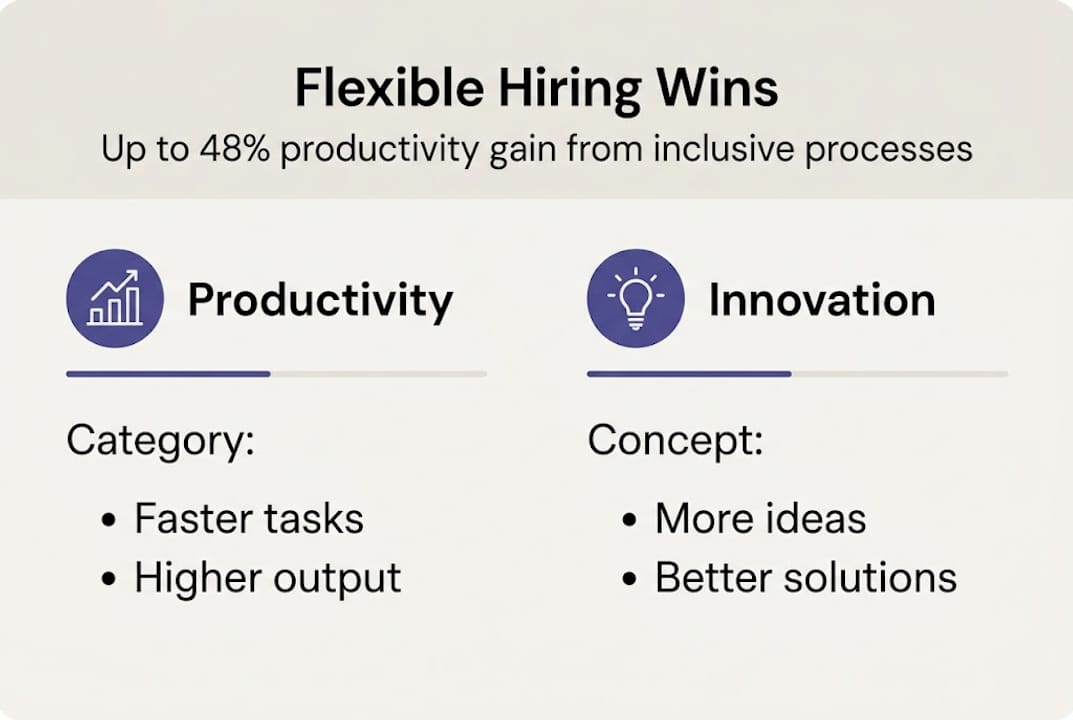
Key outcomes from leading organisations include up to 48% faster task completion, a 20% increase in innovation metrics, retention rates above 90% at SAP and Microsoft, and an 8% revenue growth attributed to neurodiverse team contributions. These are not aspirational targets. They are documented results.
| Organisation | Metric | Outcome |
|---|---|---|
| SAP | Code commits | 1.2x higher than average |
| SAP | Software defects | 15% fewer |
| Microsoft | Job applications | 45% increase |
| Microsoft | Retention | 10% improvement |
| Deloitte/EY | ROI on support | Positive, documented |
SAP and Microsoft have both published data supporting these figures, and Deloitte and EY have contributed supporting ROI analysis. This is not a niche trend. It is a mainstream competitive insight.
The retention story is particularly compelling. Turnover is one of the most expensive line items in any HR budget. When neurodivergent employees are hired through processes designed for their success and supported through structured onboarding, they stay. A 90%+ retention rate is extraordinary in most industries and represents a direct reduction in recruitment, training, and lost-productivity costs.
Key business outcomes from inclusive hiring programmes include:
- Faster task completion and higher output quality in technical roles
- Stronger problem-solving and pattern recognition in analytical functions
- Reduced defect rates in software development and quality assurance
- Higher employee engagement scores among neurodivergent and neurotypical staff alike
- Measurable revenue contribution from innovation-driven teams
"The data does not suggest that neurodivergent hiring is a risk worth taking. It suggests it is a risk worth taking seriously."
For organisations exploring inclusive employment packages, these figures provide the business justification needed to move from pilot programmes to full-scale implementation. And if you want a practical example of how this plays out in practice, the inclusive hiring insights from industry practitioners are worth reviewing.
Challenges and sector disparities: Addressing the gaps
The evidence is strong, but it would be dishonest to present flexible hiring as a frictionless journey. There are genuine obstacles, and understanding them is essential to navigating them effectively.
One of the most significant is what researchers call the manager lottery. Disclosure rates remain low at just 3 to 4%, manager quality varies enormously, autistic adult unemployment sits at around 85%, and accommodation costs present a real challenge for some organisations. The manager lottery means that a neurodivergent employee's experience can differ dramatically depending on who their line manager happens to be, regardless of the organisation's stated commitment to inclusion.
Disclosure is another barrier. When candidates do not feel safe disclosing a neurodivergent condition, they cannot request the adjustments they need. And when they mask throughout a recruitment process, they are more likely to be hired into roles or environments that do not suit them, leading to early attrition.
Sector disparities are also stark:
| Sector | Inclusive hiring maturity | Key barrier |
|---|---|---|
| Technology | High | Disclosure stigma |
| Professional services | Medium-high | Interview format rigidity |
| Retail | Low | Awareness and training gaps |
| Manufacturing | Low | Physical environment challenges |
White-collar and knowledge-based industries are ahead, but even there, implementation is uneven. Retail and manufacturing face compounding barriers around awareness, physical environment design, and management training.
To address these gaps, organisations can take the following steps:
- Invest in manager training focused specifically on neurodivergent onboarding and day-to-day support
- Create anonymous feedback channels so neurodivergent employees can flag issues without disclosure risk
- Audit job specifications to remove language that inadvertently screens out neurodivergent applicants
- Partner with specialist platforms to access inclusive job specs designed for neurodivergent applicants
- Build sector-specific accommodation guides that account for physical and environmental factors
"Accommodation costs are real, but they are consistently outweighed by the retention and productivity gains that follow."
For organisations ready to move beyond good intentions, opting in to inclusive hiring frameworks is a practical starting point that removes much of the guesswork.
Designing inclusive hiring processes: Practical strategies and frameworks
Knowing the benefits and the barriers is only useful if it leads to action. The organisations seeing the strongest results are those that have redesigned their hiring processes from the ground up, rather than bolting accommodations onto existing rigid structures.
Redesigning processes for all applicants, rather than creating separate neurodivergent tracks, is where the real ROI lies. Universal design in hiring means that the improvements benefit everyone, which also removes the stigma associated with requesting adjustments.
Here are the practical steps that make the biggest difference:
- Rewrite job descriptions to focus on outcomes and essential skills, removing vague competency language
- Provide interview questions in advance so candidates can prepare substantively rather than perform under pressure
- Offer alternative assessment formats such as work samples, portfolios, or structured task-based interviews
- Share clear information about the interview environment, format, and timeline before the day
- Train interviewers to evaluate responses on content, not delivery style
- Build structured onboarding programmes with explicit expectations, regular check-ins, and clear feedback loops
The critical framework elements that underpin all of this are:
- Clarity: Every stage of the process should be transparent and predictable
- Structure: Assessments should be consistent, skills-focused, and free from social performance bias
- Feedback: Candidates and employees should have regular, specific, and actionable feedback
- Flexibility: Adjustments should be available by default, not only on request
- Accountability: Managers should be assessed on their inclusive practice, not just their team's output
SAP's Autism at Work programme and Microsoft's Neurodiversity Hiring Programme both follow versions of this framework. Their results, already cited above, speak for themselves. For organisations looking to build this capability, exploring inclusive recruitment strategies is a logical next step. And for practical insight into how relationship-building shapes inclusive outcomes, the recruiter relationship strategies discussion offers grounded, experience-based perspective.
Pro Tip: Before redesigning your process, gather feedback from neurodivergent employees already in your organisation. They will identify the specific friction points that generic frameworks miss, and their input will make your redesign far more effective.
Why flexible hiring is a competitive advantage: What most guides miss
Most articles on this topic stop at the business case and the checklist. What they miss is the cultural shift that happens when flexible hiring is championed from the top rather than managed from HR.
When leadership treats inclusive hiring as a strategic priority rather than a compliance obligation, something changes in the organisation. Managers start asking better questions. Teams become more psychologically safe. Communication becomes clearer because clarity benefits everyone, not just neurodivergent colleagues. The ripple effect is real and it is underreported.
Prioritising redesign for all applicants, confirmed by empirical evidence, is not just a hiring tactic. It is an organisational development strategy. When your interview process is structured, your job specs are clear, and your onboarding is explicit, you are building a culture of precision and fairness that attracts and retains talent across the board.
The organisations that will lead in the next decade are those building inclusive hiring training into their management development, not treating it as a one-off workshop. Flexible hiring is not a trend. It is the direction of travel for any organisation serious about performance.
Take the next step towards inclusive hiring
The evidence is clear and the frameworks exist. What separates organisations that talk about inclusive hiring from those that deliver it is access to the right tools and support.
At urhired.ie, we have built the interview platform specifically for neurodivergent talent at scale. Whether you are looking for inclusive job spec access to attract the right candidates, tailored recruitment packages designed around your organisation's needs, or inclusive interview preparation tools that give neurodivergent applicants a genuine opportunity to perform at their best, we can help you move from intention to implementation. Your next hire could be your most impactful one.
Frequently asked questions
What is a flexible hiring process?
A flexible hiring process adapts recruitment steps, communication, and assessments to accommodate varied needs, ensuring neurodivergent applicants can demonstrate their genuine abilities. It levels the playing field rather than lowering standards.
Do flexible hiring processes cost more?
Initial accommodation costs can be higher, but net gains are documented through improved retention, reduced turnover, and productivity improvements that consistently outweigh upfront investment.
Which sectors benefit most from flexible hiring?
Technology, professional services, and knowledge-based industries currently lead in outcomes. White-collar sectors show the strongest results, while retail and manufacturing are still developing the awareness and infrastructure needed.
How do organisations start implementing flexible hiring?
The most effective first step is redesigning job specs and interview formats for all applicants, then gathering feedback from neurodivergent staff. Redesigning for all applicants rather than adding separate accommodations delivers the strongest ROI.
What is the manager lottery in neurodivergent hiring?
The manager lottery describes how a neurodivergent employee's experience varies significantly based on individual manager quality. Manager quality varies and directly impacts whether flexible hiring commitments translate into positive day-to-day experiences.